

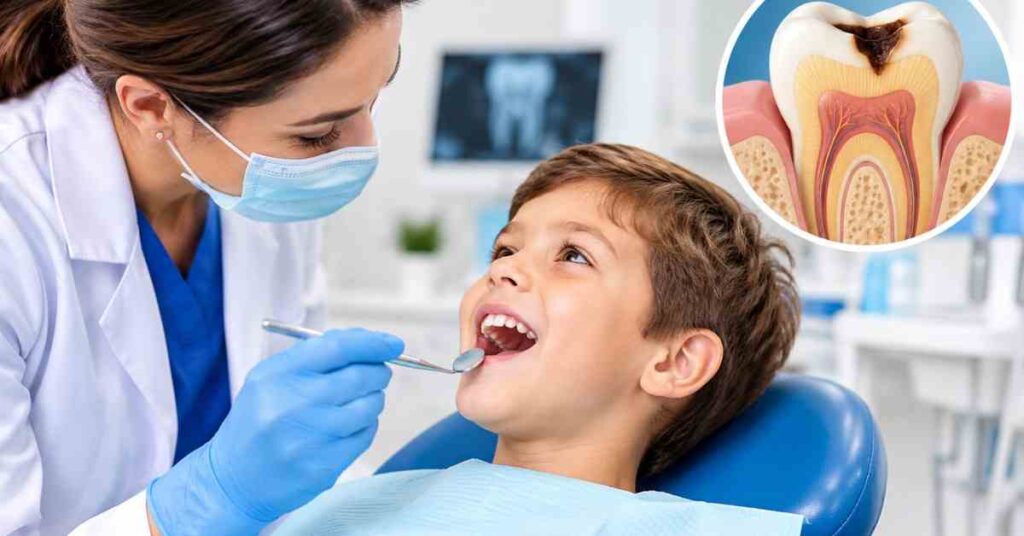
A small spot on a tooth can feel like nothing. No pain, no swelling, so why rush? The problem is that a cavity never heals on its own. It only gets bigger, and the longer it sits, the more it costs you in pain, time, and sometimes the tooth itself.
Here is what really happens when a cavity is ignored, and how families can stop it early.
What Is a Cavity, Really?
Your mouth is full of bacteria. When you eat sugar or starch, those bacteria make acid. The acid slowly eats away at enamel, the hard outer shell of your tooth. Once enamel loses enough minerals, a tiny hole forms. That hole is a cavity, also called tooth decay.
Enamel has no nerves, so early decay is usually silent. This is why many people only find out at a checkup.
How an Untreated Cavity Grows, Step by Step
Stage 1: The enamel breaks down. You may see a white or brown spot. Nothing hurts yet. A dentist can often catch it on an X-ray.
Stage 2: Decay reaches the dentin. Dentin is the softer layer under the enamel. Decay moves faster here. This is when you may notice a zing of pain with hot, cold, or sweet things.
Stage 3: The pulp gets infected. The pulp is the center of the tooth, where the nerves and blood vessels live. Once bacteria get in, you may feel a deep, throbbing ache, sometimes worse at night.
Stage 4: An abscess forms. This is a pocket of pus at the root. You may have swelling in your gum or face, a bad taste in your mouth, and fever. An abscess needs prompt care. If the infection spreads, it can become dangerous.
Stage 5: The tooth is lost. If too little healthy tooth remains, it cannot be saved. Removal may be the only choice.
Problems You Might Not Expect
Pain is not the only issue. An ignored cavity can also lead to:
- Trouble chewing, so you avoid certain foods
- Constant bad breath that brushing does not fix
- A cracked or broken tooth, because decay makes it weak
- Decay spreading to the tooth next to it
- Missed work or school because of sudden tooth pain
Many people also wait until the pain is severe, and by then the fix is bigger. A small filling becomes a root canal or a crown, and in some cases an extraction.
Why This Matters Even More for Kids
Baby teeth have thinner enamel, so decay moves quickly. Some parents think, “They will fall out anyway.” But baby teeth hold space for adult teeth and help kids chew and speak clearly. A painful tooth can also affect sleep, eating, and focus at school.
This is where children’s and family dentistry makes life easier. When the whole family sees one trusted team, habits are shared, checkups line up, and small problems get spotted early. Kids also feel calmer when they see parents go to the dentist without fear.
How Dentists Fix a Cavity at Each Stage
The sooner you act, the simpler the treatment:
- Early decay: Fluoride and better home care can sometimes stop it.
- Small to medium cavity: A filling removes the decay and rebuilds the tooth.
- Large cavity or weak tooth: Dental crowns in Acworth, GA are often used to cover and protect a tooth that is too damaged for a filling.
- Infected pulp: A root canal cleans out the infection and saves the tooth.
- Tooth that cannot be saved: After removal, dental implants in Georgia can replace the missing tooth so you can chew and smile normally again.
Notice that the last two options are bigger, take more visits, and could have been avoided with an early filling.
How to Prevent Cavities
You do not need a complicated routine. Stick to the basics:
- Brush twice a day with fluoride toothpaste, and floss daily.
- Limit sugary drinks and snacks, especially sticky ones.
- Drink water after meals.
- Help young kids brush until they can do it well alone.
- Book regular dentist cleaning services in Acworth, so plaque and early decay are removed before they spread.
A cleaning also gives your dentist a chance to look closely, take X-rays when needed, and spot trouble you cannot see or feel.
Conclusion
An untreated cavity does not stay small or quiet. It moves from the enamel to the nerve, and it can end in infection or tooth loss. The good news is that cavities are very treatable when found early. Regular checkups, good brushing habits, and a dentist your whole family trusts make a big difference. If you notice a spot, sensitivity, or pain, do not wait. Call and get it checked while the fix is still simple.
FAQs
1. Can a cavity heal on its own?
Only the very earliest stage, when enamel has lost minerals but has not broken, can sometimes be reversed with fluoride and good care. Once there is a hole, only a dentist can repair it.
2. How long can a cavity go untreated?
There is no safe time limit. Some cavities grow slowly, others fast. Diet, brushing habits, and the tooth itself all play a part, so it is best to treat it as soon as it is found.
3. Do I need a filling if my tooth does not hurt?
Yes, in most cases. Cavities often cause no pain until they are deep. Waiting for pain usually means waiting for a bigger problem.
4. Are cavities in baby teeth worth treating?
Yes. Untreated decay in baby teeth can cause pain and infection, and it can affect how adult teeth come in. It can also make eating and sleeping hard for a child.
5. What are the signs of an abscess?
Look for a throbbing toothache, swollen gums or face, a pimple-like bump on the gum, a bad taste, and fever. See a dentist right away if you notice these.
About the Author
Dr. Arjan Hayer is a dentist at Dental Care Acworth. He earned his DMD at LECOM in Sarasota and a biology degree from the University of Georgia. A member of the American Dental Association, he has extra training in dental surgery, prosthodontics, Invisalign, and endodontics.
5552 Robin Road Suite A
Acworth, GA 30102
Phone: 678-888-1554
Email: staff@dentistinacworth.com


